
Idaho Release Records Explained
Release is a change in custody, not one fixed statewide event. A county jail may let a person go on bond, recognizance, dismissal, a court order, time served, or completion of a local term. The jail may instead transfer the person to IDOC, another county, the U.S. Marshals Service, or immigration custody. Only the first group clearly describes an exit to the community. A transfer removes a name from one roster while custody continues elsewhere.
State prison records use another set of milestones. An IDOC resident may move to a community reentry center, leave prison on parole, remain in the community on supervision, or reach final sentence satisfaction. A community reentry center is still an IDOC placement. Parole means supervised release during the remaining sentence. Discharge means IDOC considers the sentence satisfied. Probation usually begins through a court order and may not follow prison at all. These differences explain why no single list captures every Idaho release.
| Event | What it means | Best record |
|---|---|---|
| County release | The local jail ended its custody through bond, court action, time served, or sentence completion. | Sheriff release or booking record |
| County transfer | The person left one jail but entered another authority's custody. | Sending record plus receiving custodian |
| Parole release | The person left an IDOC institution and remains under IDOC supervision. | IDOC detail record and Commission action |
| Sentence discharge | The IDOC sentence reached satisfaction. | Dated IDOC Discharged result |
Fields in Idaho Release Records
A local booking or release record and an IDOC detail record answer different questions. County records may identify the booking, facility, release date, release reason, charge, bond, court, and agency destination. Available fields vary by sheriff and by the software in use. A current roster often removes the person after processing, so the durable record may require a direct request.
IDOC results show an IDOC number, name, middle name, birth year, and status. The detail page can add a physical or supervising location, district, officer, case number, sentencing county, sentence status, Released to Supervision date, Sentence Satisfaction Date, Parole Eligibility Date, Next Parole Hearing Date, or Retained Jurisdiction End Date. Not every record contains each field. Multiple cases can also create several rows with different dates.
| Field | What it can establish |
|---|---|
| Release date and reason | When and why a county custodian ended its hold |
| Destination or agency | Whether the exit was a transfer instead of community release |
| Top-level IDOC status | In custody, In community, Discharged, or another statewide posture |
| Released to Supervision | The latest placement on court or Commission supervision |
| Sentence Satisfaction Date | The displayed end point for that sentence row |
| Case and sentencing county | The court record needed for a disposition cross-check |
Request Idaho Release Records
Start with the agency that created the custody event. For a county jail exit, identify the holding sheriff and ask for a narrow booking, custody, transfer, or release record. For an IDOC sentence, use the public records route for a custody-status history, release-to-supervision date, discharge record, or sentence calculation that is subject to disclosure. IDOC Sentencing Records reviews judgments, calculates terms, applies credit, and processes parole forfeiture actions, but it cannot alter a court sentence.
A precise request is easier to locate and redact. Supply the full name, birth year or date when appropriate, IDOC or booking number if known, sentencing county, case number, a clear date range, and the exact record sought. Do not ask for an entire file when one dated custody event will answer the question. Correctional, medical, victim, juvenile, security, and investigatory material may be withheld or redacted under lawful exemptions.
- Identify the county sheriff or IDOC as the record creator.
- Check the agency's public search before filing a request.
- Describe one person, event, time range, and record type.
- Submit through the sheriff's stated channel or the IDOC JustFOIA portal.
- Review any written denial for its cited exemption and attorney-review statement.
The official IDOC records portal is the statewide submission route for IDOC-created material, not a sheriff's local jail record.
Idaho Release Request Deadlines
Idaho's Public Records Act begins with a presumption that agency records are open unless an express exemption applies. The current timing rules distinguish requester residence. When more retrieval time is needed, an Idaho resident may receive notice of up to ten working days, while a nonresident may receive notice of up to 35 days. A denial or partial denial must be written and identify the legal authority and reason.
Costs differ as well. For a qualifying resident request, the first two labor hours and first 100 paper pages are free. An agency may recover qualifying actual labor and copying costs beyond those limits, using the lowest-paid staff member or attorney able to do the work. Nonresident charges may recover actual costs under the law. A resident public-interest waiver exists only when its legal tests are met.
Records law: Idaho Code §74-102 sets the access and resident-fee framework. Section 74-103 governs response timing and denials. Sections 74-105 and 74-124 address correctional and investigatory limits.
Sealed or confidential court material remains restricted. Where a sealing or expungement order applies, confirm its access effect with the filing clerk and the record custodian. Idaho has no published fixed retention promise for discharged names in the IDOC search, so an old no-result cannot prove that a person never entered state jurisdiction. County retention also depends on the local record system and policy rather than one statewide online archive.
Idaho Booking Photo Record Limits
No Idaho-specific commercial anti-pay-to-remove or mandatory mugshot deletion statute was identified in the current code and Attorney General manual review. That bounded finding does not promise access or resolve every later rule. A sheriff-held booking photo remains subject to the Public Records Act, investigatory and privacy exemptions, sealing restrictions, and the custodian's facts.
Public access also does not create a right to republish an image. Payment to a private publisher is not a public-record remedy, and no commercial removal service should be treated as an official path. Ask the sheriff that created the booking record whether the image is available. If a court record has been sealed or otherwise restricted, use the filing court's process to understand the effect on access.
Idaho County Release Routes Vary
Idaho's 44 counties do not share one jail model. Large counties operate full detention campuses. Some rural sheriffs use short-term holding functions, and jail-less counties send people to receiving facilities. Cassia and Minidoka share the Mini-Cassia regional jail. Teton's documented receiving path has varied between Jefferson and Madison, while Camas research routes people outside the county.
These arrangements make roster disappearance unusually hard to read. A person booked under one county may physically leave a receiver in another. State clients can also occupy county contract beds. The correct trail follows the arresting agency, the physical custodian, and the destination shown on the exit record. The statewide Idaho County Directory routes each local inquiry without assuming that all counties publish the same feed.
Important: A missing roster name proves only that the current display no longer shows the person. Confirm release or transfer with the agency record.
Idaho Supervision and Final Discharge
An IDOC community detail record can separate two dates that are often confused. Released to Supervision is the date the person was most recently placed on supervision by a court or the Commission. Sentence Satisfaction Date is the displayed end point for that sentence. The record may also identify the supervising district and officer. Read the sentence status with those fields because a Parole row can reflect prison release, while a Probation row may reflect direct court supervision.
The official in-community detail example displays this supervision structure.
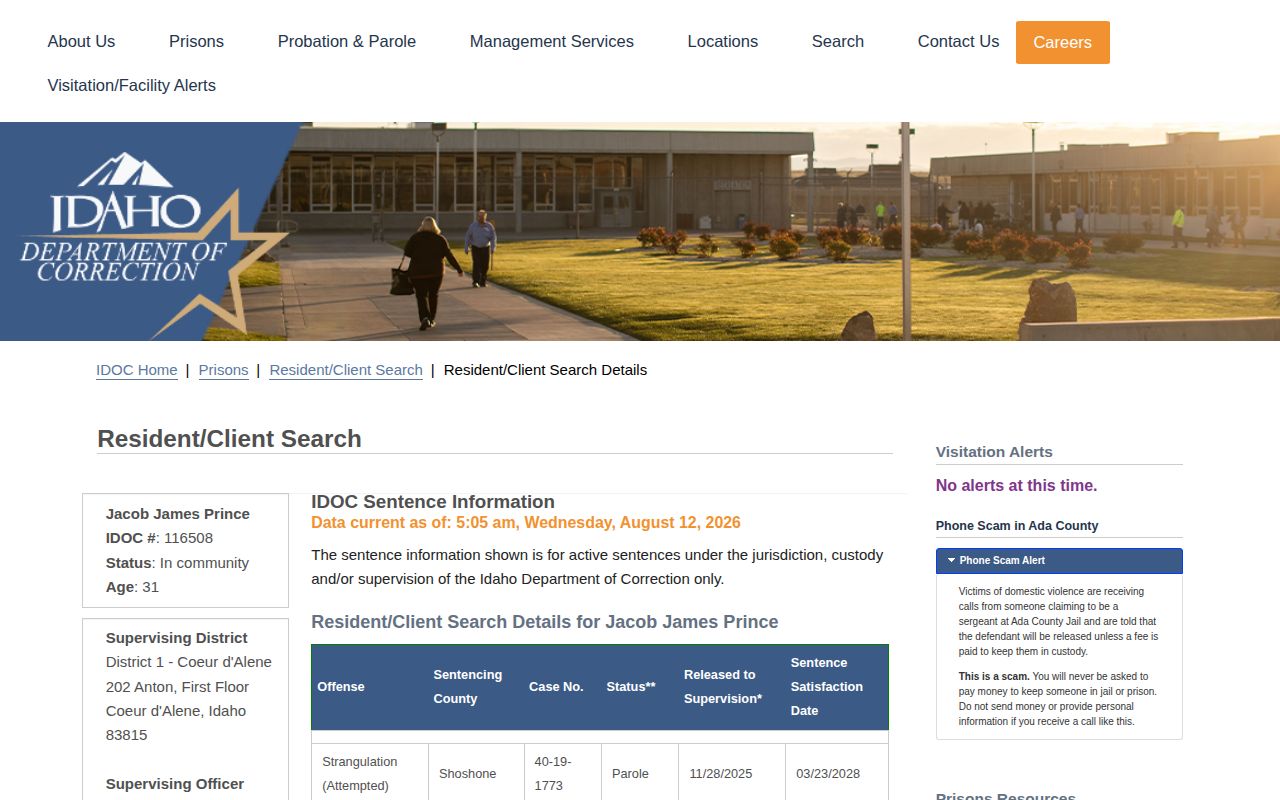
The status, sentence rows, release-to-supervision date, and satisfaction date must be read together.
Final parole discharge has a paper path too. The Commission describes a Gold Seal notice sent to the last supervision district, which then forwards it. Processing may take up to a month. A recent sentence completion may therefore call for confirmation from the district or a records request rather than an assumption that the web result and final paper notice update at once.
Idaho Release Trends Need Context
IDOC's 2026 Timely Release Report counted 912 first releases to parole during calendar 2025 for a defined group serving property or drug prison terms. Of that cohort, 754, or 83 percent, occurred before 150 percent of the fixed term, while 158 occurred afterward. The group was two percent smaller than the 926 counted for 2024. Those figures are not the total of every Idaho prison exit.
The FY2025 Community Population Report counted 15,633 people on active IDOC community supervision as of June 30, 2025, including 11,058 on probation and 4,575 on parole. The total fell 1.7 percent from the prior year. IDOC's definition excludes several groups, including people incarcerated, in federal or ICE custody, deported, absconded, on parole-violation status, on bench warrant, or on unsupervised probation. It is a supervised-population snapshot, not a list of all former inmates.
Search Idaho Released Inmates
Begin with the last known custodian. Use IDOC for a state sentence or felony supervision record. Use the holding sheriff for a local jail event. Then check the Commission when parole action is involved, iCourt for the related case, VINELink for a participating feed, BOP for a federal sentenced person, and ICE when an immigration transfer may explain the jail exit.
- Confirm the person's name, birth year, known ID, county, and last facility.
- Search IDOC by last name or IDOC number when state jurisdiction is possible.
- Open the detail page and read every sentence row, location, status, and date.
- Request the county custody-event record if the person left a local roster.
- Cross-check the court, parole, federal, or immigration channel that fits the case.
- Ask for a narrow official record when public screens conflict or omit the event.
Identity checks matter. IDOC warns that one person may have more than one number. Similar names and birth years can also lead to the wrong record. A result should match the known county, case, or identifier before it supports a release conclusion.
IDOC Search for Idaho Releases
The Idaho Department of Correction, or IDOC, calls its public locator Resident/Client Search. It covers current IDOC residents, people on felony probation or parole, and names of people who served time and satisfied their sentence. It is not a county jail archive. Search by last name, with first name optional, or by IDOC number. A partial last name needs at least two starting characters, while an IDOC number fragment needs at least three digits.
The IDOC Resident/Client Search presents the statewide name and number fields.
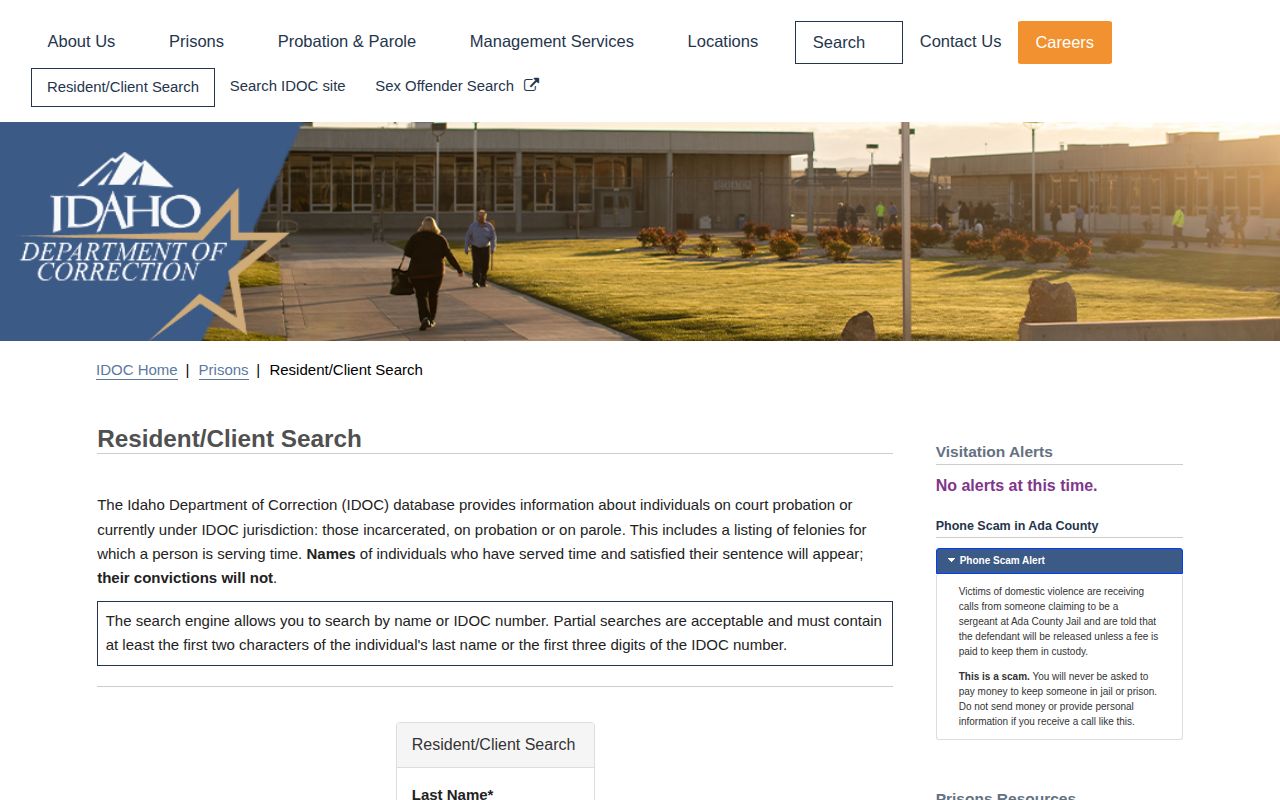
Its daily update warning makes a second source important when the release happened very recently.
The official IDOC results view shows the columns and status terms used after a search.
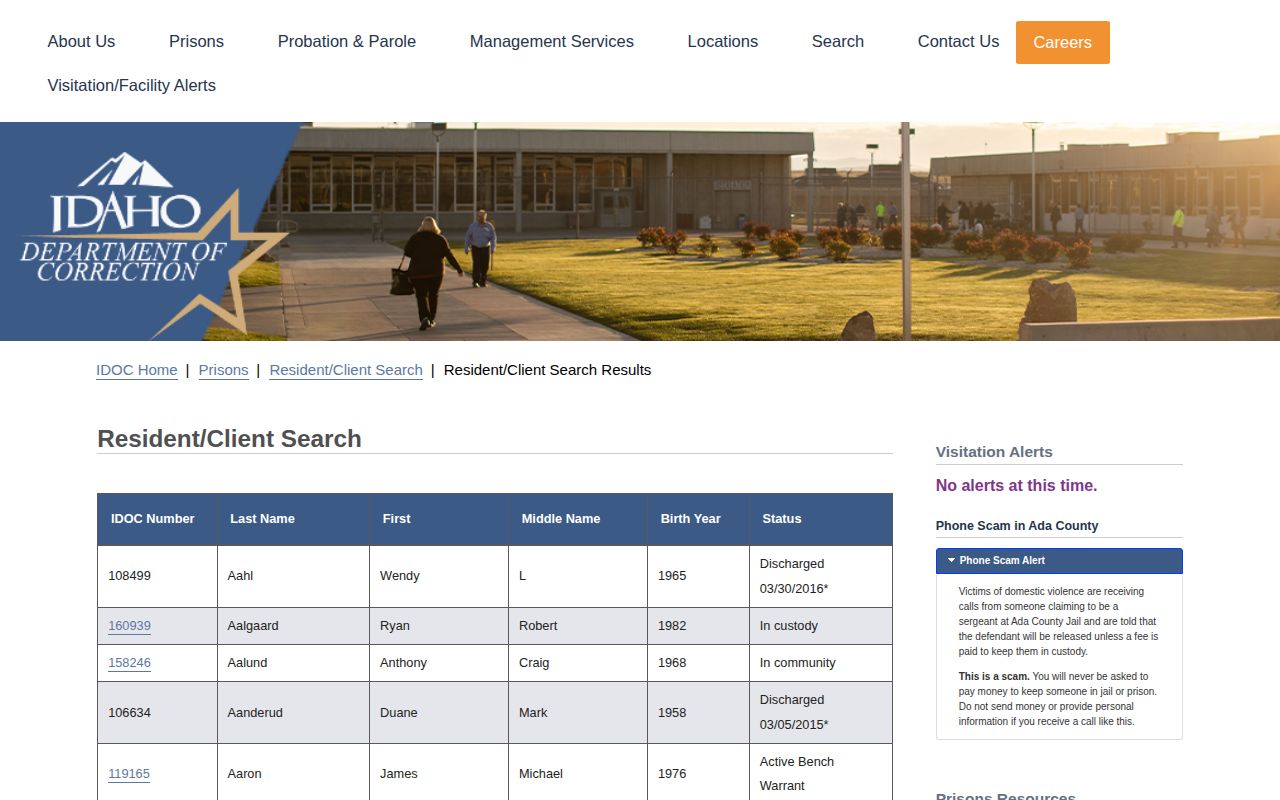
Open the detail record because a short result row cannot explain every sentence or destination.
| Search field | Rule | Use |
|---|---|---|
| Last name | Required unless an IDOC number is used; two starting characters allowed | Broad name search |
| First name | Optional | Narrows common surnames |
| IDOC number | At least three digits for a fragment | Strongest direct search |
| Birth year | Shown in results | Identity cross-check |
The IDOC offender search resource gives a deeper account of each field, status, and state-prison release path.
Idaho Discharged Status and Dates
IDOC results distinguish `In custody`, `In community`, and `Discharged MM/DD/YYYY*`. In custody means the record still places the person in an IDOC custody setting. In community links the person to active supervision, which may be parole or probation. A dated Discharged result means the sentence has been satisfied, and the public entry no longer displays the convictions. An Active Bench Warrant or fugitive-related status is not a clear release result.
The official discharged detail example shows the dated satisfaction display.
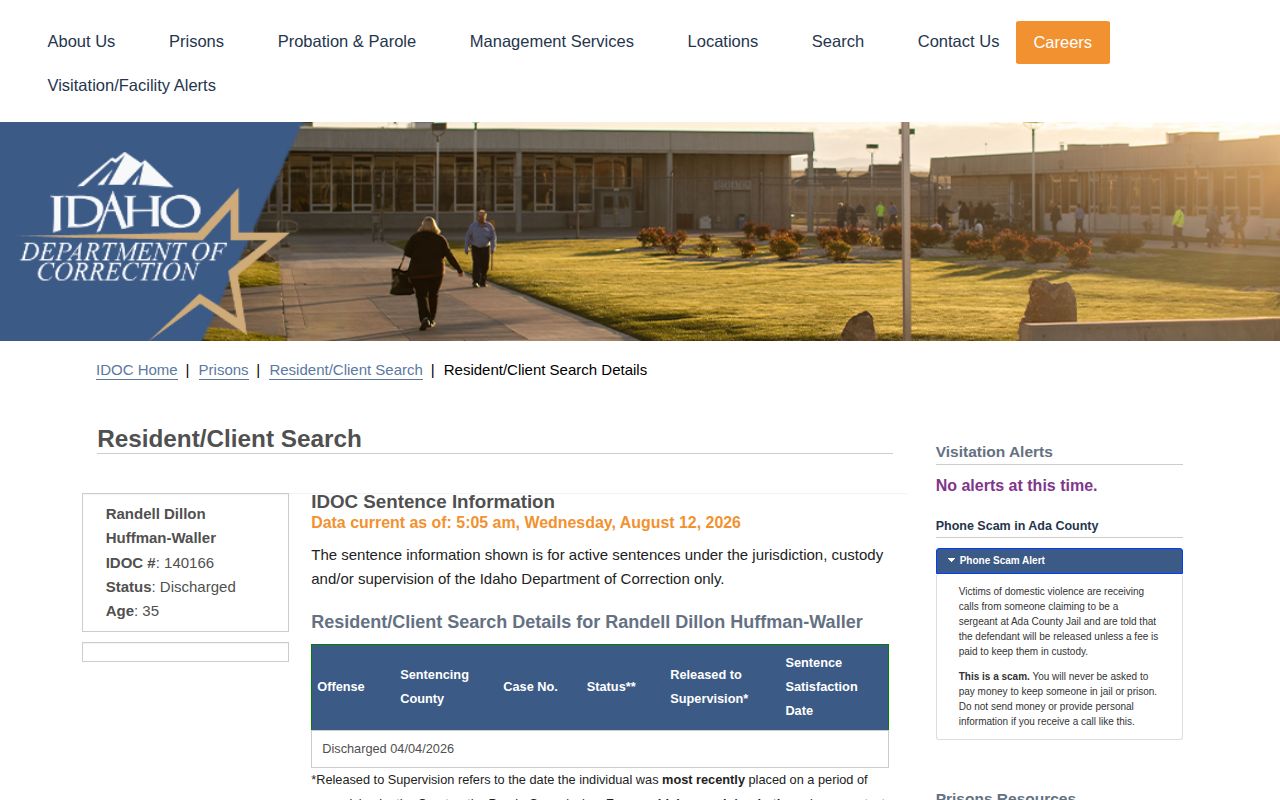
The discharge date may be later than the day the person first left prison for parole.
| Source result | What it supports | What it cannot prove alone |
|---|---|---|
| County roster absence | The live display no longer lists the person | Community release or destination |
| IDOC In community | An active community supervision posture | Whether the row is parole or probation |
| IDOC Discharged | State sentence satisfaction on the shown date | The original prison departure date |
| Commission grant | Conditional approval for parole | Actual release from the institution |
Idaho Parole Release Cross-Checks
The Commission of Pardons & Parole posts schedules and Notices of Action. These sources explain a parole decision but do not replace the later custody record. A Grant Parole date is tentative. Required programs, an approved parole plan, and final IDOC processing must occur, and actual departure can be later. Grant Parole to Detainer Only means movement to another authority rather than ordinary community release.
The Commission hearing schedule shows the official calendar and its change warning.
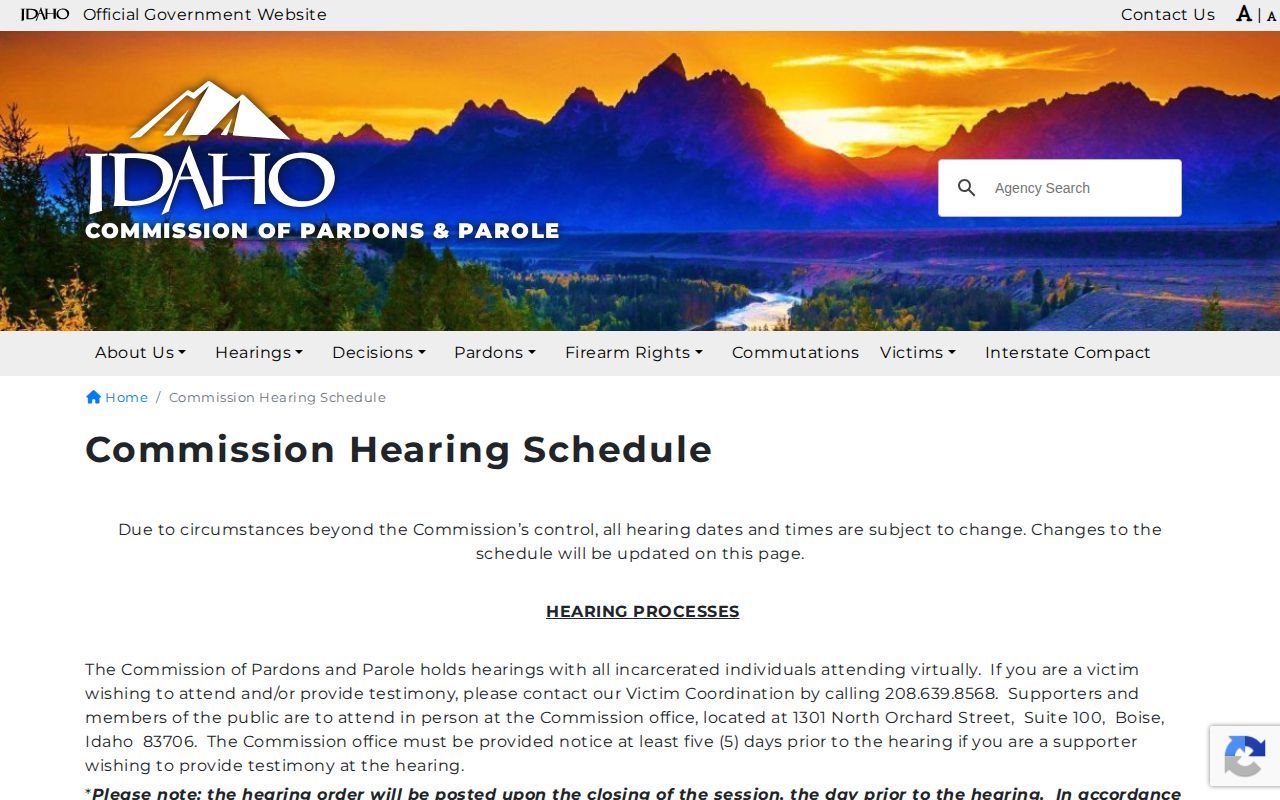
Schedule placement shows that a matter is set for review, not that release has occurred.
The Commission decisions archive publishes the action notices.
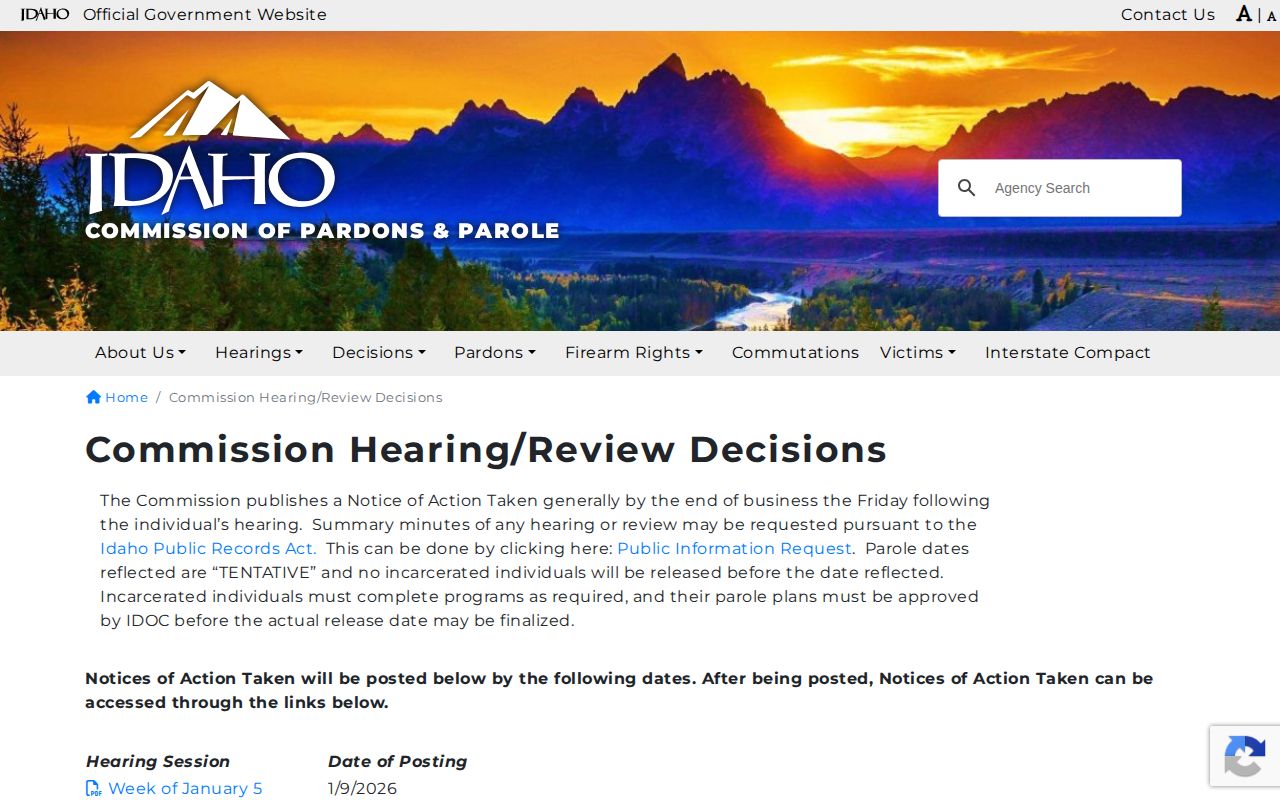
Match the IDOC number and decision, then return to the IDOC detail record to verify the post-event status.
Idaho Release Alerts and BOP
Idaho VINE provides notification through participating jail feeds and IDOC. Select Idaho in VINELink, choose the relevant agency or custody source, locate the person, and use the available registration control for phone, text, or email. Coverage should be checked in the live selector because no official static list proves that every county feed is always available. An alert is a prompt to verify the event with the jail or IDOC.
The official VINELink state selector is the entry to Idaho person searches and registration.
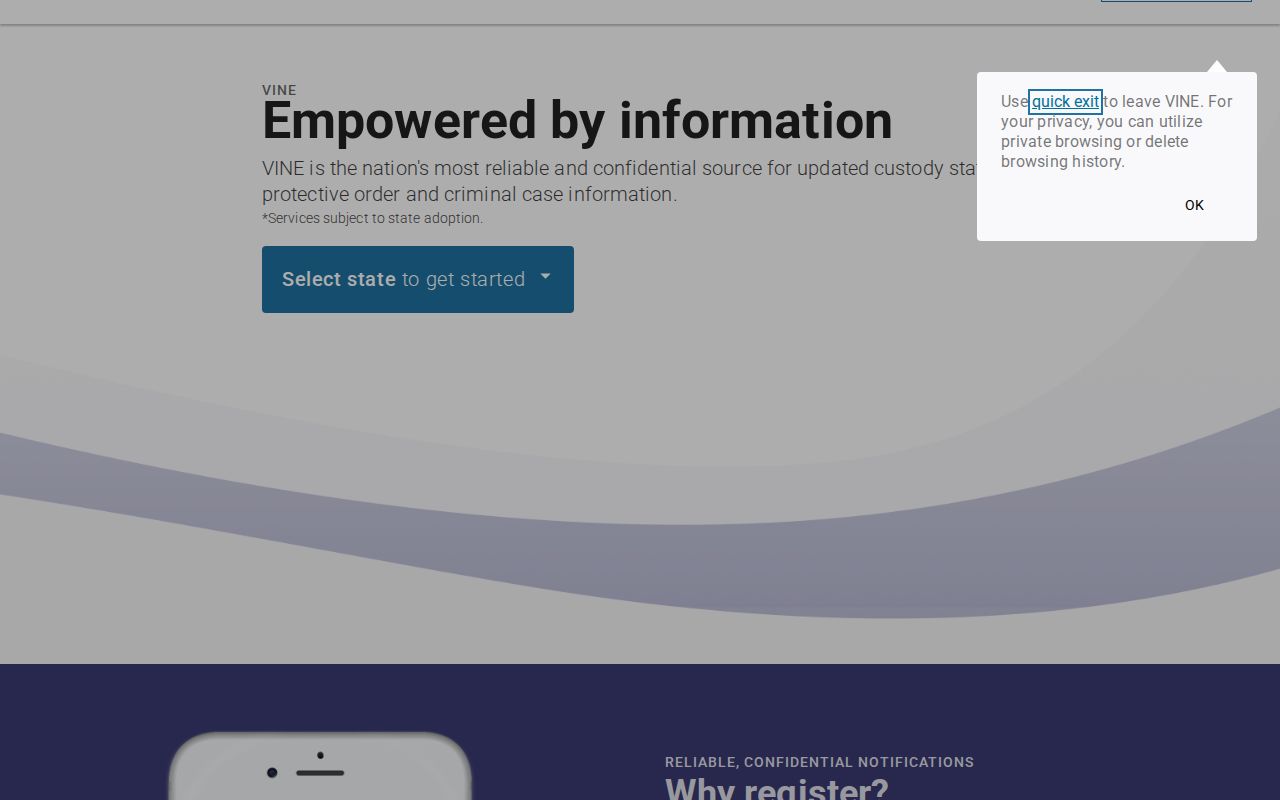
VINELink is a notification channel, not a permanent county release archive.
For federal sentenced custody, use the BOP locator. It covers federal people released after 1982. A past Release Date with no current facility, or a location of RELEASED, means the person is no longer in BOP custody. A future date is projected, while UNKNOWN means the term is not determined. No BOP-operated prison was identified in Idaho, so an Idaho federal case may involve a local contract bed before sentence and an out-of-state institution later.
The BOP Inmate Locator offers federal name and number searches.
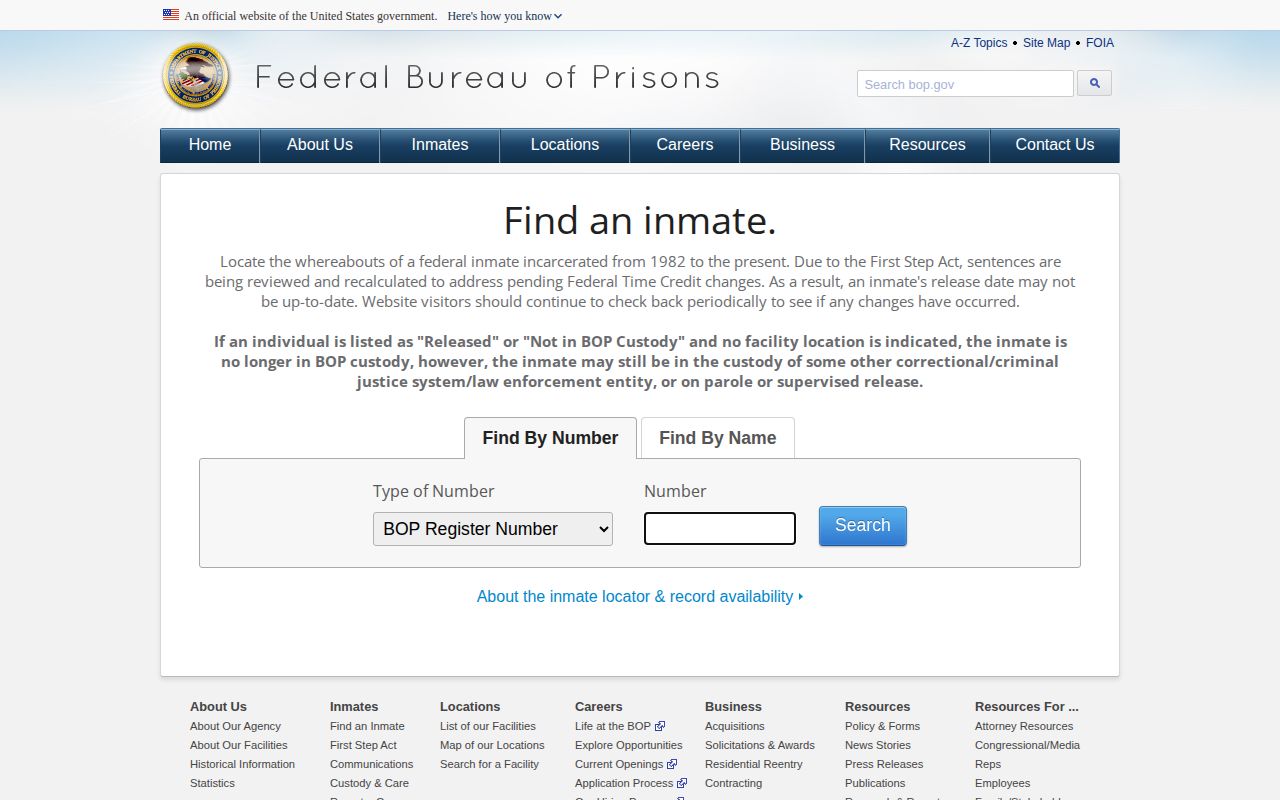
A BOP release does not rule out supervision or custody by another agency.
Idaho iCourt Release Context
iCourt supplies statewide general case and disposition information that may remain after a jail roster changes. It can show the case tied to a dismissal, sentence, probation order, or later proceeding. It does not track physical custody in real time, so a case result alone cannot declare that the person left a jail or prison.
The Idaho iCourt Portal provides that statewide case context.
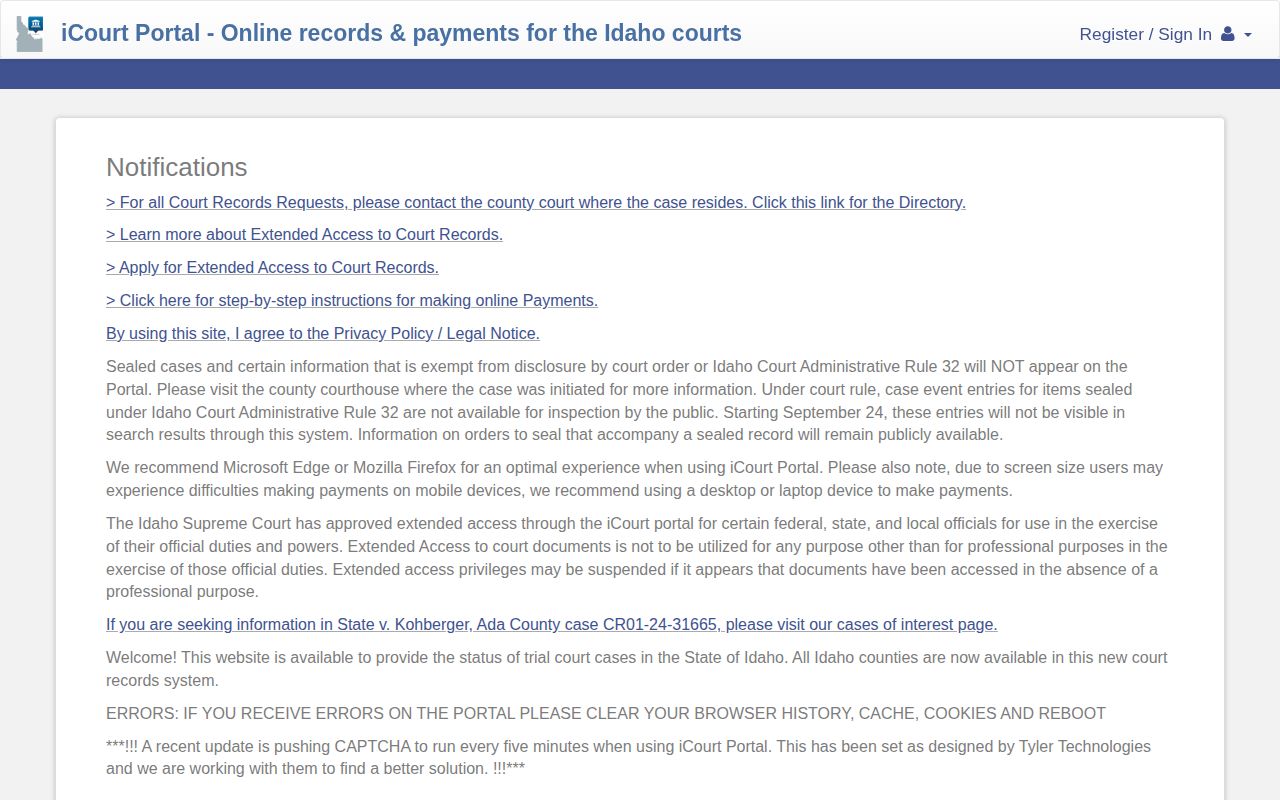
Use the filing county and case number to connect the court result to the correct custody record.
Idaho also splits general case access from access to the actual file. Documents are obtained through a courthouse kiosk or the clerk where the matter was filed. Judicial records follow Idaho Court Administrative Rule 32, not merely the executive and local Public Records Act. Sealed and confidential records remain restricted. This makes iCourt a strong cross-check, but a poor substitute for the dated release, transfer, or supervision record.
Idaho ICE Release Checks
Use the ICE Online Detainee Locator when a county jail exit may have led to civil immigration custody. The A-number route requires nine digits and country of birth, so a shorter A-number must be left-padded with zeros. The name route uses exact-match identity fields. The locator does not search minors under 18. ICE says its scope includes current detainees, people in CBP custody longer than 48 hours, and people released from ICE custody during the prior 60 days.
A no-result does not prove community release. Spelling, processing lag, age limits, a brief CBP interval, transfer, removal, or the 60-day window can explain a miss. Contact the proper ICE Enforcement and Removal Operations office when the public locator cannot resolve the record. Even a released-from-ICE result describes a custody change, not necessarily the person's present physical location or final immigration outcome.
Verify Every Idaho Release Event
The strongest conclusion joins at least two matching sources. A county release record can prove the local exit and destination. IDOC can show state custody, community status, or sentence discharge. A Commission notice explains a parole action. VINELink can flag a change. BOP and ICE cover separate federal systems, while iCourt supplies the case setting.
When sources disagree, favor the agency that created the event and request its record. Recent changes may not reach a daily search at once. Transfers can also create a gap between systems. Match the full name, birth year, ID number, case, county, and date before deciding that two entries concern the same person. Release from one authority never proves that no other warrant, detainer, case, custody term, or supervision period exists.