
Idaho Parole and Probation Compared
Parole and probation can both place a person under Idaho Department of Correction supervision in the community. Their legal origins differ. The Commission of Pardons & Parole decides whether an eligible state prisoner may serve the indeterminate part of a sentence outside prison. A sentencing court orders probation, sometimes instead of prison and sometimes after another court-controlled disposition. IDOC administers day-to-day felony supervision for both groups under Idaho Code §20-219.
The top line In community does not settle which path applies. Read the sentence-status row. A Parole row paired with Released to Supervision supports release from prison to parole. A Probation row reflects court supervision and may have no prison-release event behind it. Several cases can create several rows, dates, and statuses, so the latest controlling sentence must be identified before treating the result as complete.
| Point | Parole | Probation |
|---|---|---|
| Who orders it | Commission of Pardons & Parole | Sentencing court |
| What precedes it | Prison confinement under a unified sentence | A court judgment; prison may not be involved |
| Who supervises | IDOC probation and parole district | IDOC probation and parole district for felony cases |
| Best public clue | In community, a Parole row, and Released to Supervision | In community with a Probation row |
| How it ends | Sentence satisfaction or qualifying Commission discharge | Court termination and later record updates |
The IDOC in-community detail view shows how a supervision office, officer, sentence type, and release-to-supervision date can appear together.
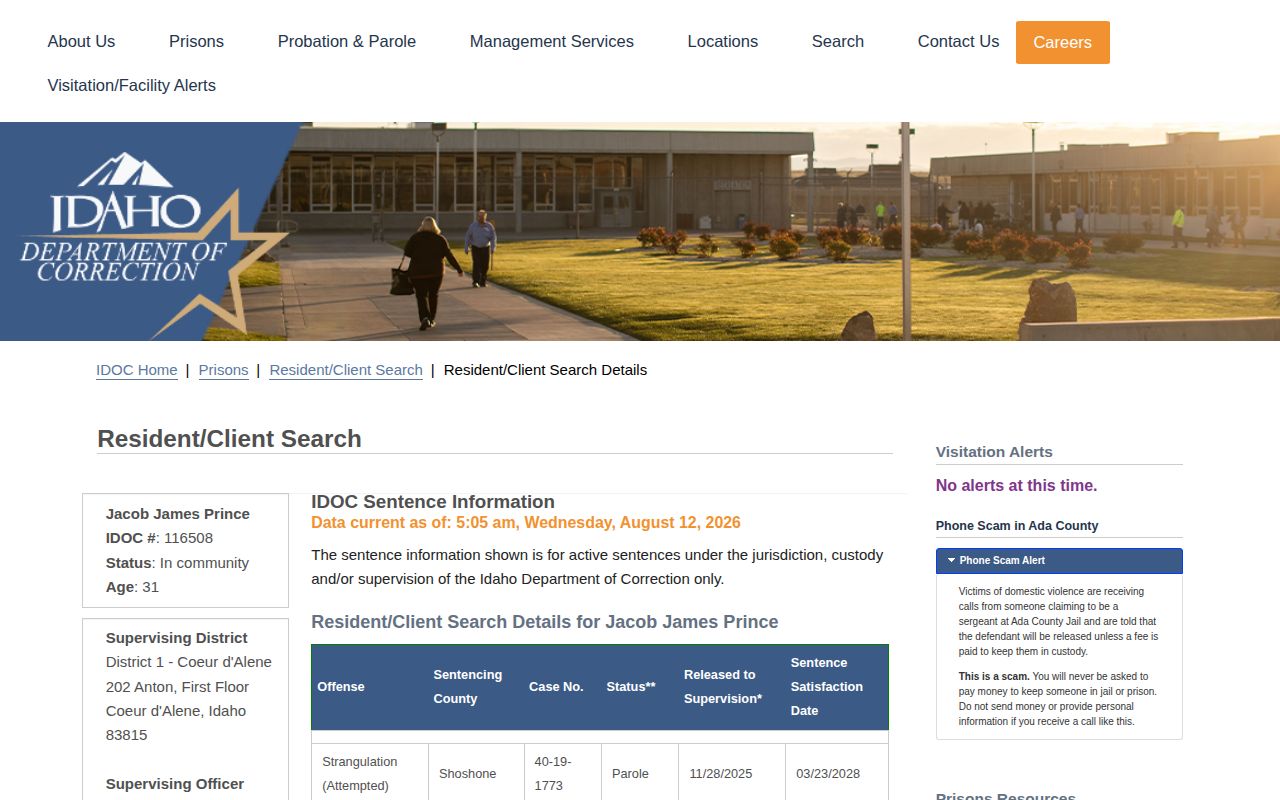
That combination is more useful than the broad community banner alone because it connects the status to a specific sentence and supervising district.
Check Idaho Post-Release Supervision
The statewide verification path starts with the official Resident/Client Search. It contains people incarcerated under IDOC, clients on felony probation or parole, and names of people whose sentences are satisfied. The database refreshes daily, yet IDOC warns that a location, status, scheduled termination date, or other detail can change fast. A fresh district confirmation is valuable when timing matters.
- Open the IDOC Resident/Client Search. Use the IDOC number when known, or search by last name and narrow by first name and birth year.
- Match the IDOC number, name, and birth year. IDOC warns that one person can have more than one IDOC number, so inspect all plausible records.
- Open the detail page. Note the top status, supervising district, officer and phone, then read every sentence row.
- Separate a Parole row from a Probation row. Record Released to Supervision and Sentence Satisfaction Date without treating them as the same event.
- If the record is unclear or concerns an interstate transfer, use the listed district and the official statewide office directory to confirm that the public office information is current.
The Resident/Client Search form explains its minimum name and ID-number inputs as well as the daily-update limit.
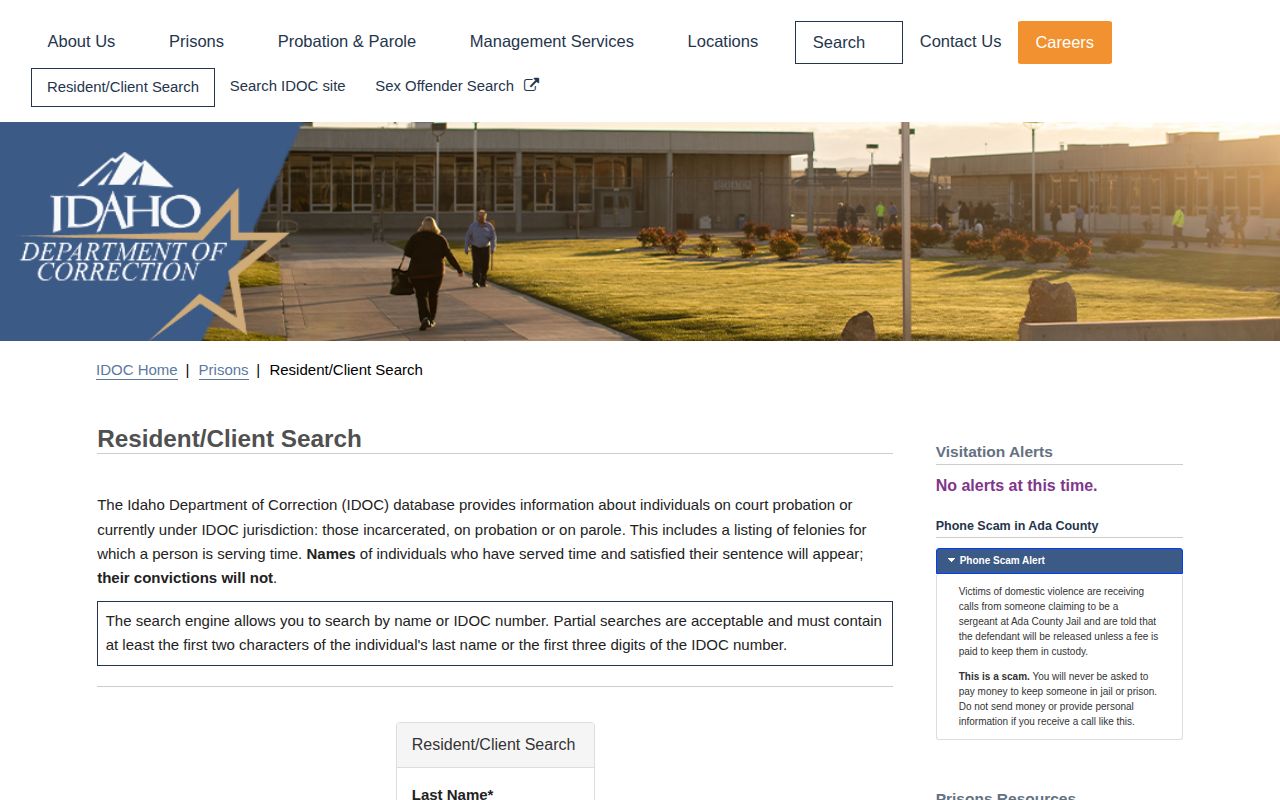
A result is a starting record. The detail view and responsible district provide the context needed to distinguish active supervision from discharge.
Note: A person missing from a county jail roster may have transferred to IDOC or another custodian rather than entered community supervision.
Idaho Supervision District Contacts
IDOC operates seven probation and parole districts. There is no sound reason to route every supervision question to one local office. The correct district depends on the client record and county, while an interstate case may require extra confirmation. The detail page can display the supervising district, office address, officer, and phone number. Use that information with the current official directory instead of guessing from where the person was sentenced or imprisoned.
Probation and Parole District Offices
Statewide district directory
Use the district named in the live client record.
A narrow inquiry can identify the client and ask whether the displayed office assignment remains current. It should not assume that case-plan, treatment, victim, security, or investigatory material is open. The public detail page and district can confirm routing without promising access to protected file contents.
Sentencing county and present supervision district may differ. A person can also move between districts or enter Idaho through an interstate supervision arrangement. For that reason, a county name in one sentence row is not a safe substitute for the office listed at the top of the current detail page. Start with the live assignment, then let IDOC redirect the inquiry if the client recently moved.
The IDOC home page places probation and parole within the statewide correctional system.
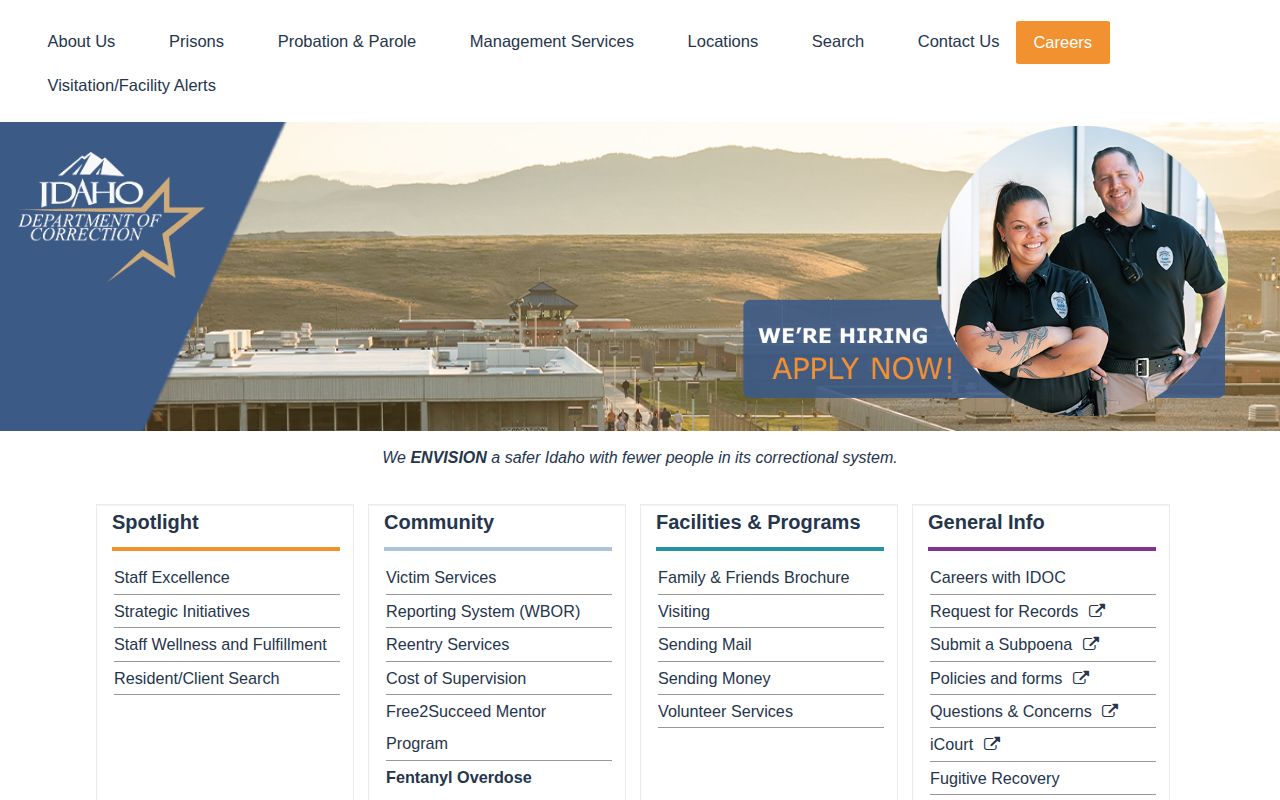
This agency identity matters because the Commission makes parole decisions, while IDOC carries out community supervision after a grant is finalized.
Note: Use the district shown on the current client record because sentencing county and present supervision office can differ.
Idaho Supervision Terms Defined
Small wording changes can signal a major change in legal status. These definitions keep the public IDOC fields separate from informal ideas about being out of jail or finished with a sentence.
- Parole
- Community service of the remaining sentence after a discretionary Commission grant and final release processing.
- Probation
- Court-ordered community supervision that may occur without a prior state-prison release.
- Released to Supervision
- The date IDOC says the person was most recently placed on supervision by a court or the Commission.
- Sentence Satisfaction Date
- The displayed end point for a sentence row, not always the day of physical prison release.
- Discharge
- The end of IDOC sentence jurisdiction, shown publicly as a dated discharged status when the sentence is satisfied.
- Absconder
- A person alleged to have stopped required contact or left supervision controls; it is not a completed-supervision status.
Multiple rows need separate review. A person may have one sentence on probation, another on parole, and a warrant or violation that changes the current posture. The result should never be reduced to one label without reading the full record.
Idaho Violations and Warrant Status
An Active Bench Warrant, fugitive marker, parole-violator row, or absconder-related status is not proof that a person has completed parole or probation. It shows an unresolved supervision or court issue. IDOC may issue time-sensitive fugitive notices, but those notices are not a stable statewide list of released people. The live client record and assigned district are the better verification sources.
Conditions and violation responses vary by the order, sentence, and case. IDAPA 06.02.01 supplies statewide supervision rules, while a court retains power over probation and the Commission handles parole revocation decisions. A public result may show enough to direct the inquiry, but it does not expose every report or decision behind the status. If immediate safety is at issue, contact law enforcement rather than trying to locate the client directly.
A violation also changes which document answers the question. A court docket can show a probation warrant or later order. A Commission Notice of Action can show a parole revocation, reinstatement, or new hearing. The IDOC client page then shows the current correctional posture. None of those records should be substituted for the others. Read the date and issuing authority on each item, then seek current confirmation when the records appear to conflict.
The IDOC results view demonstrates the range of high-level status labels returned by the statewide system.
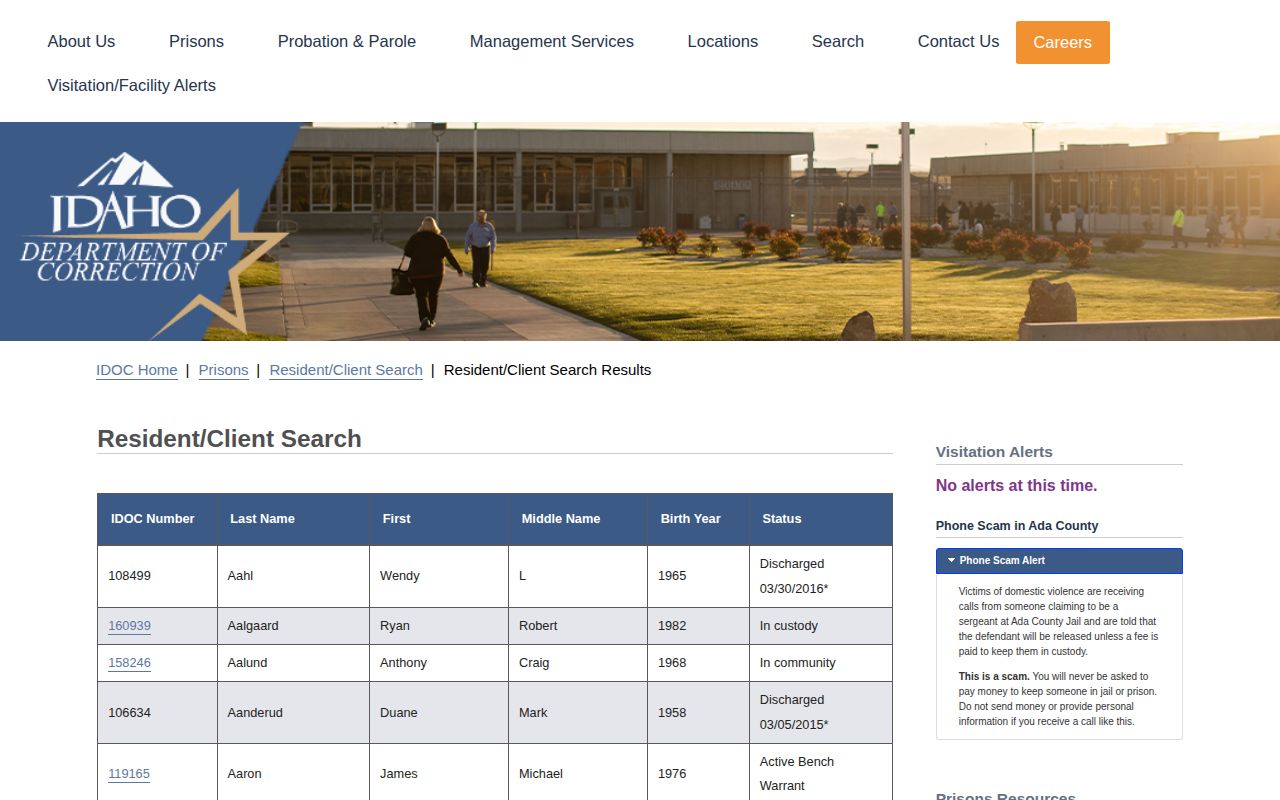
Those labels should be read with the sentence rows because In community, a warrant, and a dated discharge reflect very different stages.
Note: A warrant or violator label calls for current agency verification and does not show that a person is free of state control.
Idaho Limited Supervision Status
IDOC’s Limited Supervision Unit is a statewide, lower-contact format for qualifying clients. It uses monthly online reporting while the client’s legal duties remain in force. The agency reported more than 1,800 clients in the unit as of its February 12, 2026 update. The count describes that program at that point in time, not all probation or parole cases.
Limited supervision is still supervision. It is not a sentence discharge, a court termination, or proof that all IDOC authority has ended. A client assigned to the unit should still be read as active unless the sentence and official record show otherwise. The distinction is useful when a person has less face-to-face contact but still appears In community in the state search.
Idaho Reentry Before and After Release
IDOC describes reentry planning as beginning when a resident arrives and becoming more focused near a possible release. A pre-release course covers practical preparation and contact with probation or parole. Some higher-need cases are referred to a reentry specialist who coordinates a plan and may continue contact for about 90 days after release. The official Reentry Services material is the proper source for current program navigation.
Idaho’s five operating community reentry centers are structured IDOC placements. They are not unconditional discharge sites. East Boise, Treasure Valley, Idaho Falls, Nampa, and Twin Falls were operating on the research date. A Pocatello center was marked as coming soon for late fall 2026, so it should not be treated as an open placement without a later agency notice.
The Reentry Summary Guide tells released clients to report promptly to probation or parole, connect with assigned reentry contacts, obtain identification documents, and meet legal reporting duties. Those steps show why a physical exit onto parole begins a new supervised phase instead of ending the sentence.
A community reentry center also has to be read as a physical placement, not a supervision label. Someone at a CRC may be nearing parole or another release, yet remains in a structured IDOC setting. Check the physical location, top status, sentence row, and release-to-supervision field together before describing that person as released to the community.
Note: Placement at an Idaho community reentry center remains an IDOC placement and does not itself establish community release or discharge.
Idaho Supervision and Final Discharge
Parole may end at sentence satisfaction or through a qualifying Commission discharge order. Under Idaho Code §20-233, the Board may ask the Commission for a final order that discharges the remaining parole period. Probation ends through the court because the sentencing court retains jurisdiction over probation termination. These routes should not be blended.
IDOC can expose two useful dates in an active community record. Released to Supervision marks the most recent placement on supervision. Sentence Satisfaction Date points to the displayed sentence end. The Commission FAQ also describes a final discharge notice called a Gold Seal. It goes to the last supervision district for forwarding and may take up to a month to process.
The public search preserves names after a sentence is satisfied but suppresses the former conviction detail in that discharged entry. That design makes the dated status useful for confirming the end of IDOC jurisdiction, yet it can provide less case detail than an active record. When the exact case or path matters, match the discharge to the sentencing county and case through the court record or request a defined IDOC record.
A dated Discharged result is stronger public evidence that IDOC regards the sentence as satisfied. It may be later than the original prison exit because parole can continue after physical release. For a recent end date, check the supervising district, court order where probation is involved, and a narrow records request rather than assuming the web status and paper notice changed at the same time. The statewide Idaho released-inmate search path explains how local custody, IDOC supervision, and court records fit together.